

Most small businesses for sale in India are family businesses. A promoter built it over 15 or 25 years, ran it with relatives or long-time loyal staff, and is now selling because of retirement, health, or the next generation choosing a different career. This is a different transaction from buying a professionally-run, systemized company, and it comes with its own specific risks and negotiation dynamics that generic due diligence advice doesn't fully cover.
This guide walks through what changes when the seller is a family, not a corporate entity.
Why Buying a Family-Owned Business in India Is Different
A professionally-run business sale is largely a numbers exercise: verify the financials, agree a price, transfer ownership. A family business sale carries an additional layer, because the business and the owner's identity are often the same thing. The promoter isn't just selling an asset, they're handing over something they built, and that shapes everything from the negotiation tone to what's actually documented.
Three structural differences show up consistently.
1. Informal Financial Records in Family-Owned Businesses
Family businesses, especially those run for a decade or more without professional management, frequently keep looser financial records than the business's actual revenue would suggest. Common patterns:
- Cash transactions not fully reflected in books, sometimes to reduce tax exposure, sometimes just from years of informal habit
- Owner expenses mixed with business expenses: a family car, personal travel, or relatives on payroll doing minimal actual work
- Multiple sets of numbers: what's reported for tax, what's shown to a bank for a loan, and what the owner tells you privately may all differ
None of this necessarily means fraud. It often means the business has been run the way a family managed it for 20 years, not the way a buyer needs it documented. Your due diligence has to dig past the stated numbers rather than accept them, and you should expect to spend more time normalizing financials than you would with a corporatized target.
2. Employee Loyalty in Family Business Acquisitions
In a family business, key employees are frequently loyal to the promoter personally, sometimes because they're relatives, sometimes because of decades-long personal relationships. This creates a retention risk that doesn't show up in a standard organizational chart review.
Questions worth asking before you close:
- Which employees are related to the seller, and do they intend to stay after the sale?
- Does the business depend on informal knowledge the owner holds in their head, supplier relationships built on personal trust, or customer relationships tied to the owner's name?
- Will long-serving staff accept a new, unrelated owner, or does the sale trigger an exodus?
A business that looks operationally stable on paper can lose its most experienced people within months of a family exit if this isn't addressed directly with the seller before signing.
3. Negotiating With a Family Business Owner in India
Negotiating with a founder who built the business is different from negotiating with a private equity seller or a corporate divestiture team. Price anchoring, walk-away points, and deal pacing all behave differently.
What typically shows up:
- Attachment to a number that isn't grounded in financials: the owner may have a price in mind tied to what the business means to them, not what it earns
- Sensitivity around legacy and continuity: many family sellers care more than a corporate seller would about whether the business, the brand name, or the staff will be treated well after the sale
- Slower decision timelines, particularly when multiple family members need to agree, or when the sale carries emotional weight around a life's work ending
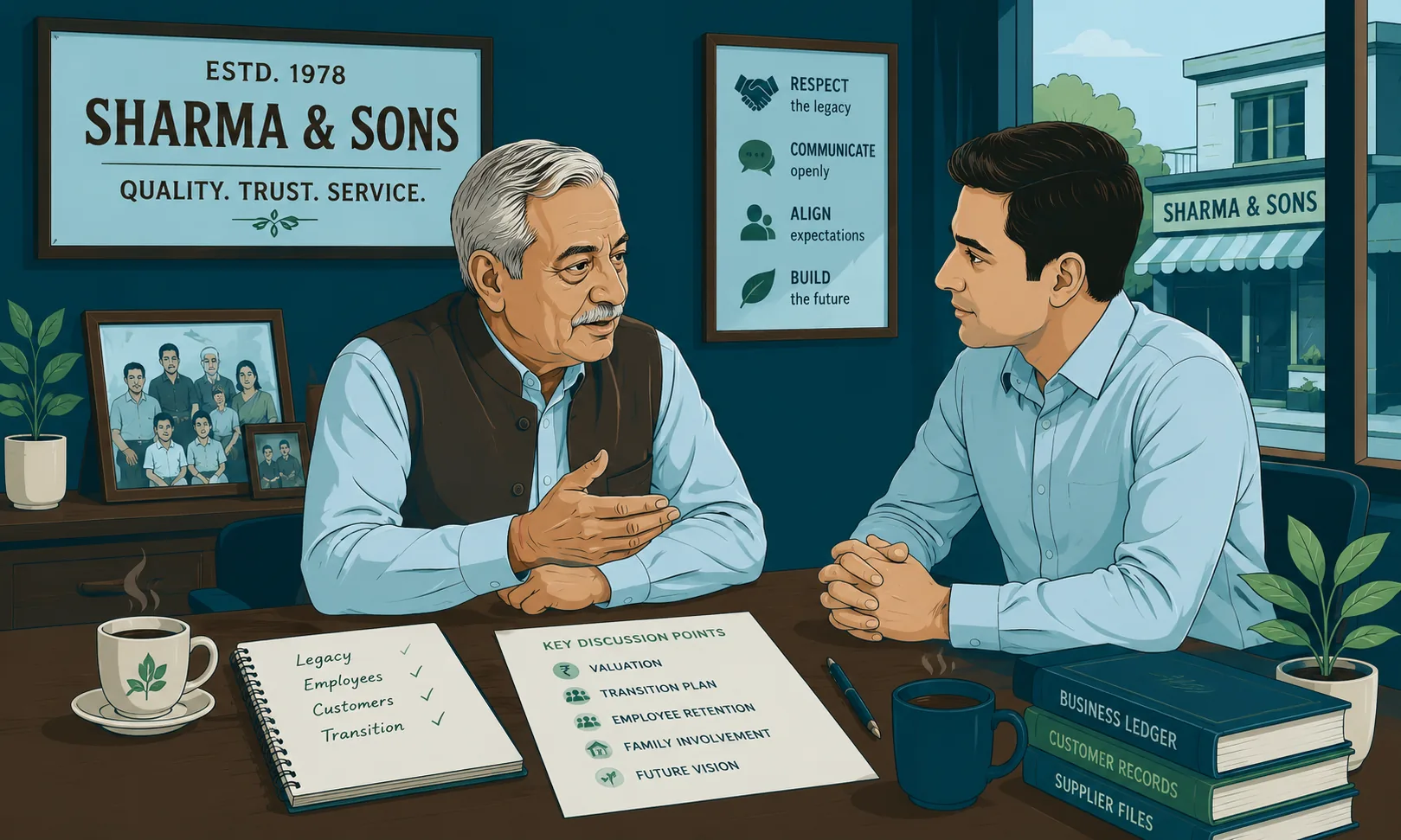
This isn't necessarily a disadvantage for a buyer. Sellers who are motivated by continuity and legacy, rather than purely maximizing price, are often more open to structures like seller financing, transition consulting periods, or earnouts, precisely because those structures keep them involved and demonstrate you'll run the business responsibly.
Family Business Succession Due Diligence Checklist
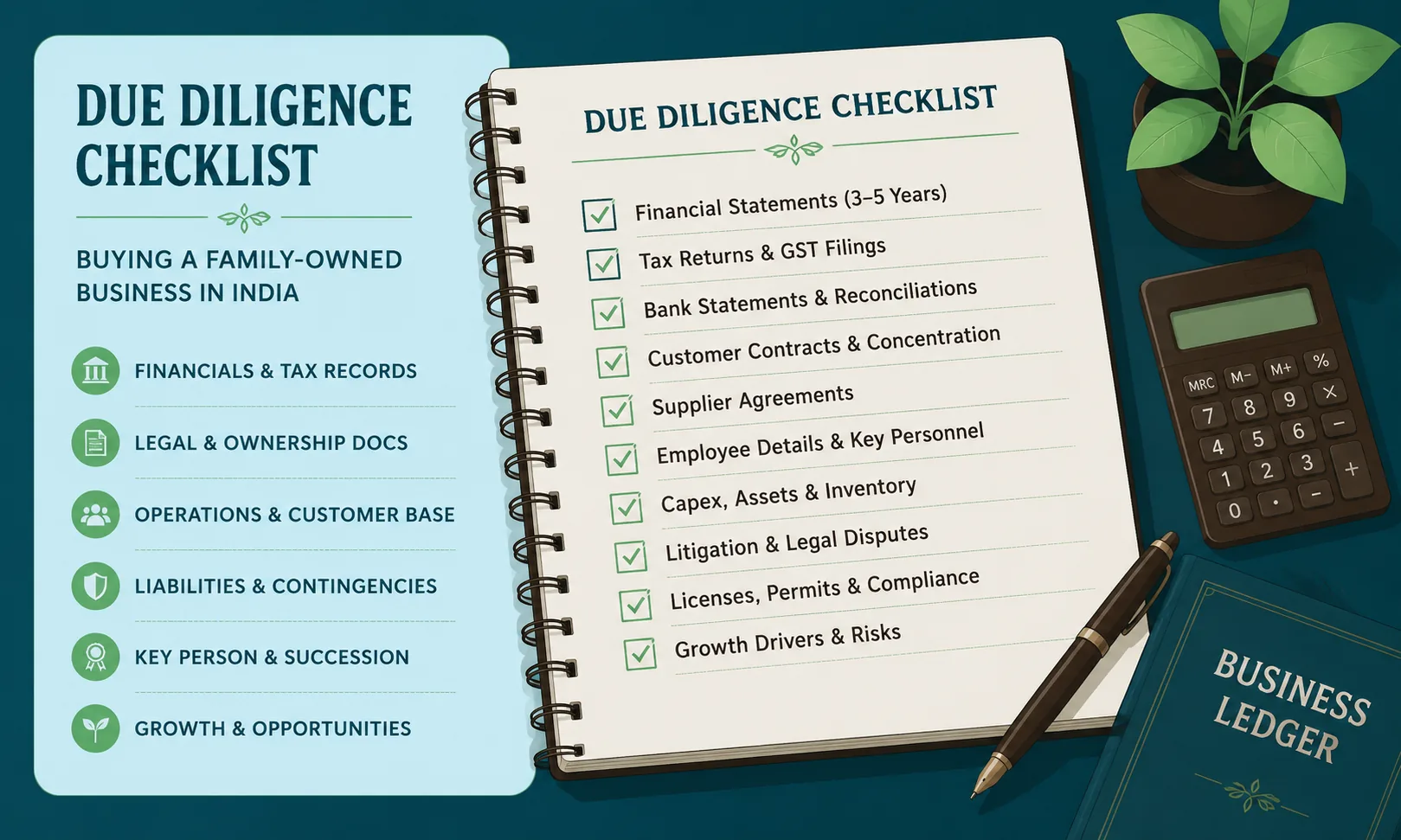
Beyond standard financial, legal, and operational due diligence, add these checks specific to family business acquisitions:
- Family employment audit: list every employee related to the seller, their actual role and output, and whether they're staying post-sale
- Verbal agreement inventory: identify supplier terms, customer arrangements, or informal understandings that were never written down and depend on the current owner's personal relationships
- Owner dependency mapping: determine specifically which functions only the owner can perform, and build a realistic transition timeline around those, not an assumed one
- Multiple financial record reconciliation: compare tax filings, bank statements, and any informal figures the seller shares privately, and treat discrepancies as a starting point for negotiation, not a dealbreaker to walk from automatically
- Family agreement confirmation: verify all owners (siblings, spouse, adult children with a stake) are actually aligned on the sale, not just the person you've been negotiating with
How to Structure an Acquisition of a Family-Owned Business
Family business acquisitions often benefit from structures that address the emotional and operational transition, not just the price:
- A transition consulting period, where the seller stays on for 3 to 6 months post-sale to hand over supplier and customer relationships personally
- Seller financing or an earnout tied to retained customers, which gives the seller confidence the business (and their legacy) will be looked after, while protecting you if customer relationships don't transfer as smoothly as promised
- Written retention agreements with key family or long-serving employees, ideally signed before closing, not negotiated after
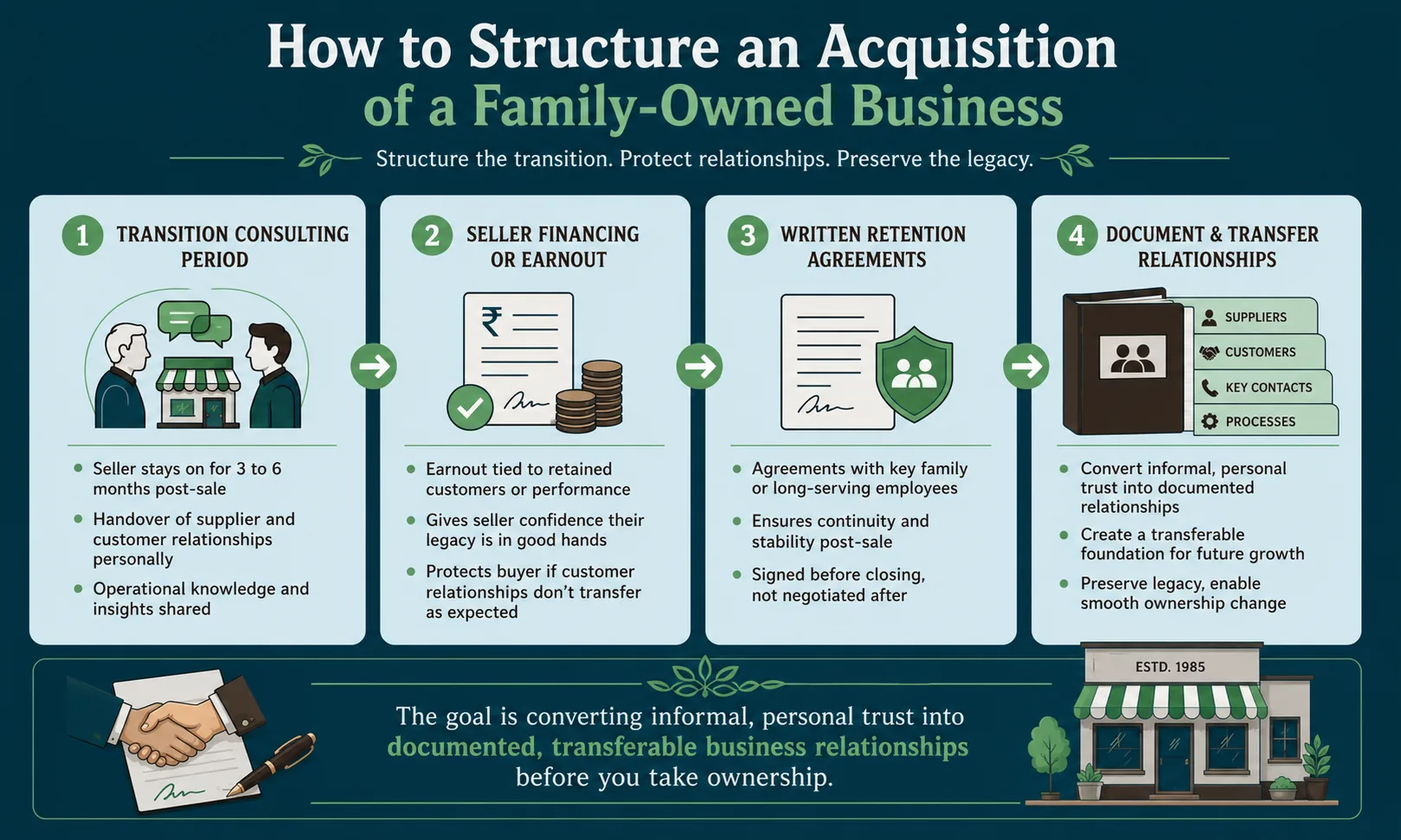
The goal is converting informal, personal trust into documented, transferable business relationships before you take ownership.
Red Flags When Buying a Family-Owned Business
A few patterns are worth treating as caution signs rather than automatic dealbreakers, since they're common enough in family sales that walking from every one would rule out most of the market:
- Reluctance to share full financial records early, when it stems from decades of informal bookkeeping rather than active concealment
- A seller who wants to remain heavily involved post-sale in a way that suggests they haven't actually decided to exit
- Key relatives or staff who are notably absent from negotiations but clearly influential in daily operations
None of these mean walk away. They mean slow down, ask directly, and structure the deal to account for what you find.
Not inherently riskier, but the risks are different in kind. Financial informality and owner/employee dependency need more attention; outright fraud or complex corporate liabilities are often less of a factor than in larger, professionally-run targets.
Start by reconciling all available records, bank statements, tax filings, and GST returns, against what the seller states verbally. A CA experienced in SME valuations can normalize the numbers, but expect the process to take longer and require more documentation requests than a business with clean, audited books.
It depends heavily on how the transition is handled. Direct conversations with key staff before closing, retention agreements for critical roles, and a visible transition period with the outgoing owner all improve the odds significantly compared to a sudden, unexplained ownership change.
Not necessarily. A defined transition period, where the seller supports the handover of relationships and knowledge, is often valuable. The concern is a seller who wants to stay indefinitely involved in decisions, which usually signals they haven't actually committed to the exit.
Looking to acquire a family-owned business in India? We build the pipeline and run the diligence before you engage a seller.
Begin the Conversation