

Buy-side M&A advisory is professional support for the buyer in a business acquisition — someone who finds, evaluates, negotiates, and closes a deal on your behalf, instead of you doing it alone.
If you've ever thought about buying an existing business instead of starting one from scratch, this guide explains where a buy-side advisor fits into that process, and why most first-time buyers in India don't go through it solo.
- A buy-side advisor works only for the buyer — sourcing, valuing, and vetting deals in your interest.
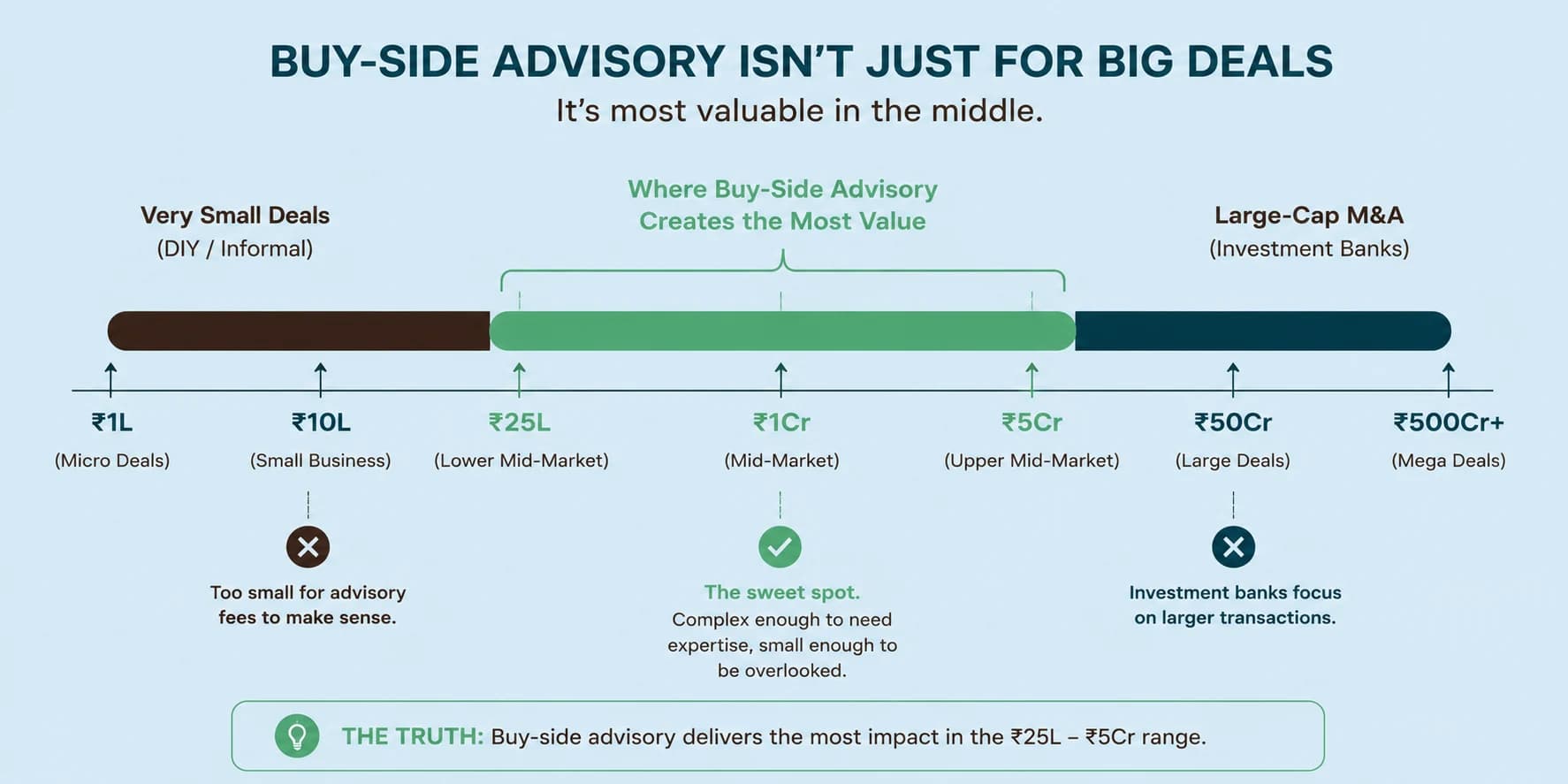
- It's not just for large M&A — search funds and individual buyers use it for deals as small as ₹25L–5Cr.
- The biggest risk without one: overpaying, or missing a liability that surfaces only after you've signed.
What Does a Buy-Side Advisor Actually Do?
A buy-side advisor represents the buyer's interests from the first conversation to the final signature. Their job breaks down into five stages:
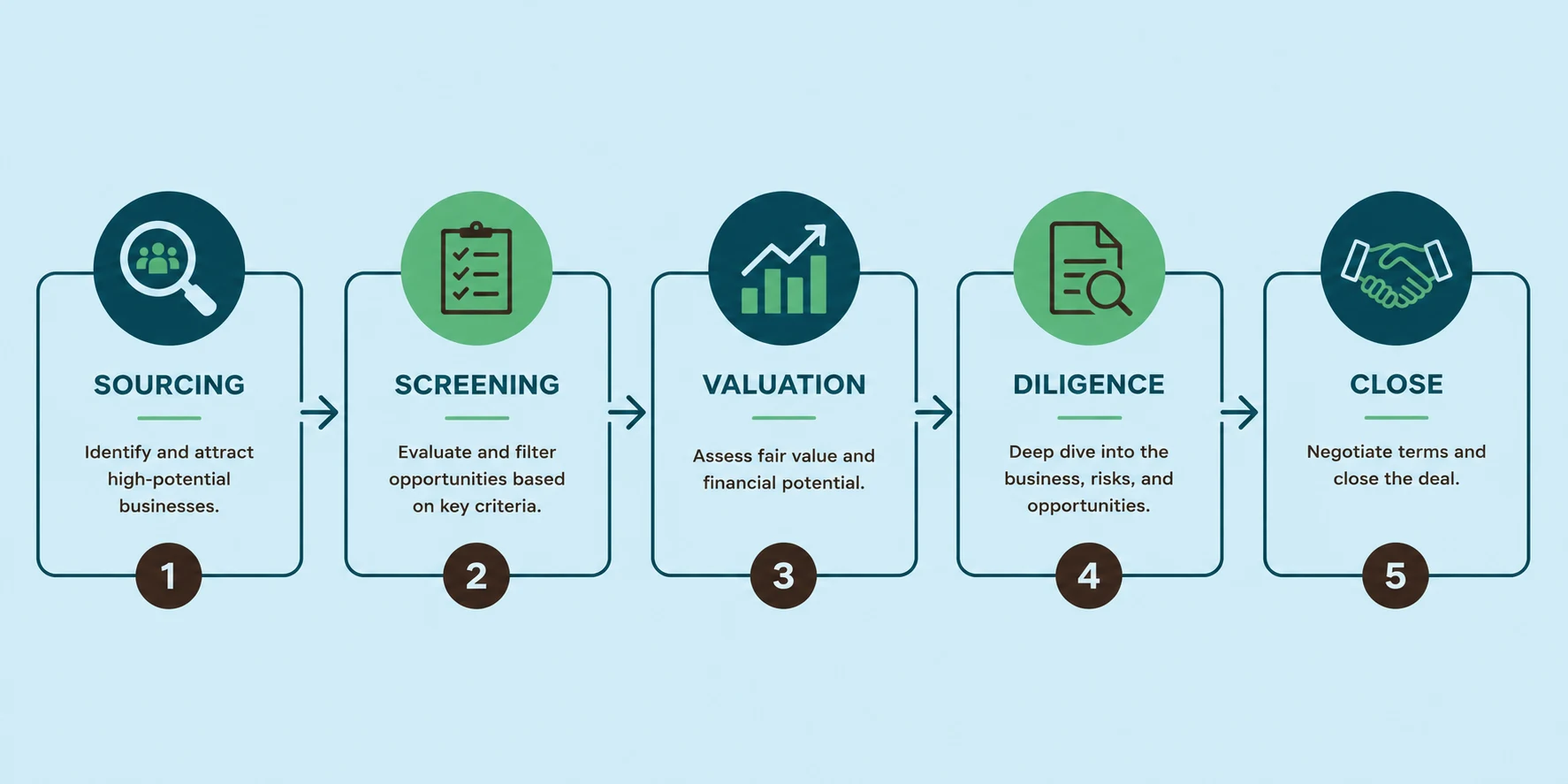
- Sourcing — identifying businesses that match your budget, industry, and goals, including off-market opportunities that never get publicly listed. Industry estimates suggest a large share of small-business acquisitions in India happen off-market, sourced through direct relationships rather than public listings.
- Screening — filtering targets by financial health, growth potential, and fit, so you only spend time evaluating serious options instead of chasing every lead.
- Valuation — assessing what a business is actually worth, using earnings multiples, comparable transactions, and discounted cash flow analysis — not just the seller's asking price.
- Due diligence — verifying financials, legal standing, contracts, licenses, and liabilities before you commit capital.
- Negotiation & closing — structuring deal terms, financing, and paperwork to protect your interests through to signing.
Buy-Side vs. Sell-Side Advisory
In short: a sell-side advisor works for the seller, a buy-side advisor works for you.
| Sell-Side Advisor | Buy-Side Advisor | |
|---|---|---|
| Represents | The seller | The buyer |
| Goal | Maximize sale price | Minimize overpayment risk, maximize deal quality |
| Sources deals from | Their own client (the seller) | The broader market, including off-market targets |
| Typical fee alignment | % of sale price | Retainer + success fee on close |
If you're buying and working with someone who represents the seller — or no one at all — you're at an information disadvantage:
- They know things about the business you don't.
- Their incentives don't point in your direction.
- You have no one independently checking the seller's numbers.
Why First-Time Buyers in India Use a Buy-Side Advisor
- Access to off-market deals. Many of the best acquisition targets in India are never publicly listed — they're sourced through networks and direct outreach.
- Avoiding overpayment. Without independent valuation, buyers commonly anchor on the seller's numbers, which are rarely neutral.
- Navigating diligence blind spots. Family-owned and small-to-mid businesses in India often have informal record-keeping, unclear ownership structures, or contingent liabilities (pending litigation, unpaid statutory dues, informal related-party arrangements) that are easy to miss without experience.
- Regulatory complexity. Depending on structure, acquisitions can involve company law, tax, and — for NRI or foreign buyers — FEMA compliance.
- Time. Sourcing and vetting targets alone can take months of unproductive searching; an advisor filters this down to serious, qualified opportunities.
Is Buy-Side Advisory Only for Large Acquisitions?
No — this is a common misconception. Search funds, individual entrepreneurs, and small holding companies increasingly use buy-side advisory for deals in the crores range, not just large institutional M&A. If you're evaluating a search-fund style acquisition, see our guide on what a search fund is for how that model works alongside buy-side advisory.
What the Buy-Side Process Looks Like, Step by Step
- Define your acquisition criteria. Industry, size (revenue/EBITDA range), geography, and budget — a clear mandate makes sourcing efficient instead of random.
- Sourcing and initial outreach. A pipeline of matching targets, including off-market approaches to owners who haven't publicly signaled they're selling.
- Preliminary screening and management calls. Targets are filtered by basic financial health and strategic fit before deeper work begins.
- Indicative valuation and offer. A preliminary valuation range is built and a non-binding letter of intent (LOI) is issued to the seller.
- Due diligence. Financial, legal, tax, and operational checks — most red flags surface here, and it's where an advisor's experience matters most.
- Final negotiation and deal structuring. Price, terms, and structure (earnouts, seller financing) are adjusted based on diligence findings.
- Closing. Legal documentation, regulatory filings, and fund transfer to complete the acquisition.
Common Mistakes First-Time Buyers Make Without an Advisor
- Trusting seller-provided financials at face value instead of independently verifying them.
- Skipping legal diligence on contracts, licenses, and pending litigation.
- Underestimating working capital needs post-acquisition, leading to a cash crunch right after closing.
- Negotiating price without negotiating terms — structure (earnouts, escrow, non-competes) often matters as much as headline price.
- Not planning the transition — losing key employees or customer relationships in the handover period.
A Quick Example: How This Plays Out
Here's a simplified version of a pattern we see often, to make the risk concrete:
A first-time buyer finds a manufacturing business through a broker, at an asking price based on the seller's self-reported EBITDA. Without independent valuation, the buyer has no way to know whether that number holds up.
What a buy-side advisor would catch:
- Revenue concentration. If 60%+ of revenue comes from one customer, that's a material risk the asking price doesn't reflect — buyer-side diligence surfaces this before the offer, not after.
- Add-back inflation. Sellers often add back “one-time” expenses to inflate EBITDA. An advisor tests which add-backs are legitimate versus optimistic.
- Working capital gaps. The deal may look fully priced on paper but leave the buyer under-capitalized for day-one operations — advisors model this before closing, not during the first cash crunch.
None of this requires the deal to be large or complex — it's exactly the kind of gap that shows up in small and mid-sized acquisitions, which is where most first-time buyers in India are actually looking.
How Kautilya's Buy-Side Process Works
Kautilya works exclusively on the buy side — we don't represent sellers, so there's no conflict of interest in what we recommend. Our process follows our approach: sourcing qualified targets, running valuation and diligence, and supporting negotiation through close. You can see real acquisitions we've supported in our portfolio and read detailed case studies in our stories.
Fee structures vary by firm and deal size, but most follow a retainer plus success fee model — a fixed monthly or upfront fee during sourcing and diligence, plus a percentage tied to the deal actually closing. This aligns the advisor's incentive with finding you a genuinely good acquisition, rather than billing hours regardless of outcome. Ask any advisor to walk through their fee structure and what triggers the success fee before engaging them.
Sourcing to close typically runs three to nine months, depending on target availability, how well-documented the business is, and diligence complexity. Smaller, well-documented businesses with clean financials can close faster; family-owned businesses with informal record-keeping often take longer because diligence has more to untangle.
Yes, if you haven't done independent valuation and diligence yet. Advisors add the most value at exactly this stage — verifying whether the deal you've already found is actually priced fairly and structured safely, not just helping you find deals in the first place.
An advisor manages the overall deal — sourcing, valuation, negotiation strategy, and coordinating the diligence process — while a lawyer drafts and reviews the legal documentation and handles regulatory filings. Most serious acquisitions use both, with the advisor coordinating the process end-to-end and looping in legal counsel at the right stages.
Yes, and it's often more important in that case. Cross-border acquisitions add FEMA compliance, repatriation rules, and sector-specific foreign investment restrictions on top of the usual diligence — a locally experienced advisor helps navigate all of this alongside your legal counsel.
There's no fixed cutoff, but as a rough guide: once a deal is large enough that a bad valuation or a missed liability would meaningfully hurt you financially, an advisor's fee is cheap insurance. In practice, this covers most deals from a few tens of lakhs upward, not just large-cap acquisitions.
Reference material
- Investopedia, Business Valuation methods overview — general reference for the valuation methodologies mentioned (earnings multiples, comparable transactions, discounted cash flow).
- Reserve Bank of India, FEMA overview — general reference for cross-border and NRI/foreign-buyer compliance considerations.
Labelled inference, not data
The share of small-business acquisitions in India happening off-market, and the ₹25L–5Cr “sweet spot” range for buy-side advisory value, are Kautilya's structural reasoning from deal experience, not published statistics. No formal India-wide dataset on off-market deal share is cited or claimed.
Not investment advice. This is an explainer for people evaluating acquisition paths, not a recommendation to pursue one.
Evaluating your first acquisition in India? We work exclusively on the buy side — sourcing, valuation, and diligence, start to close.
Begin the Conversation