
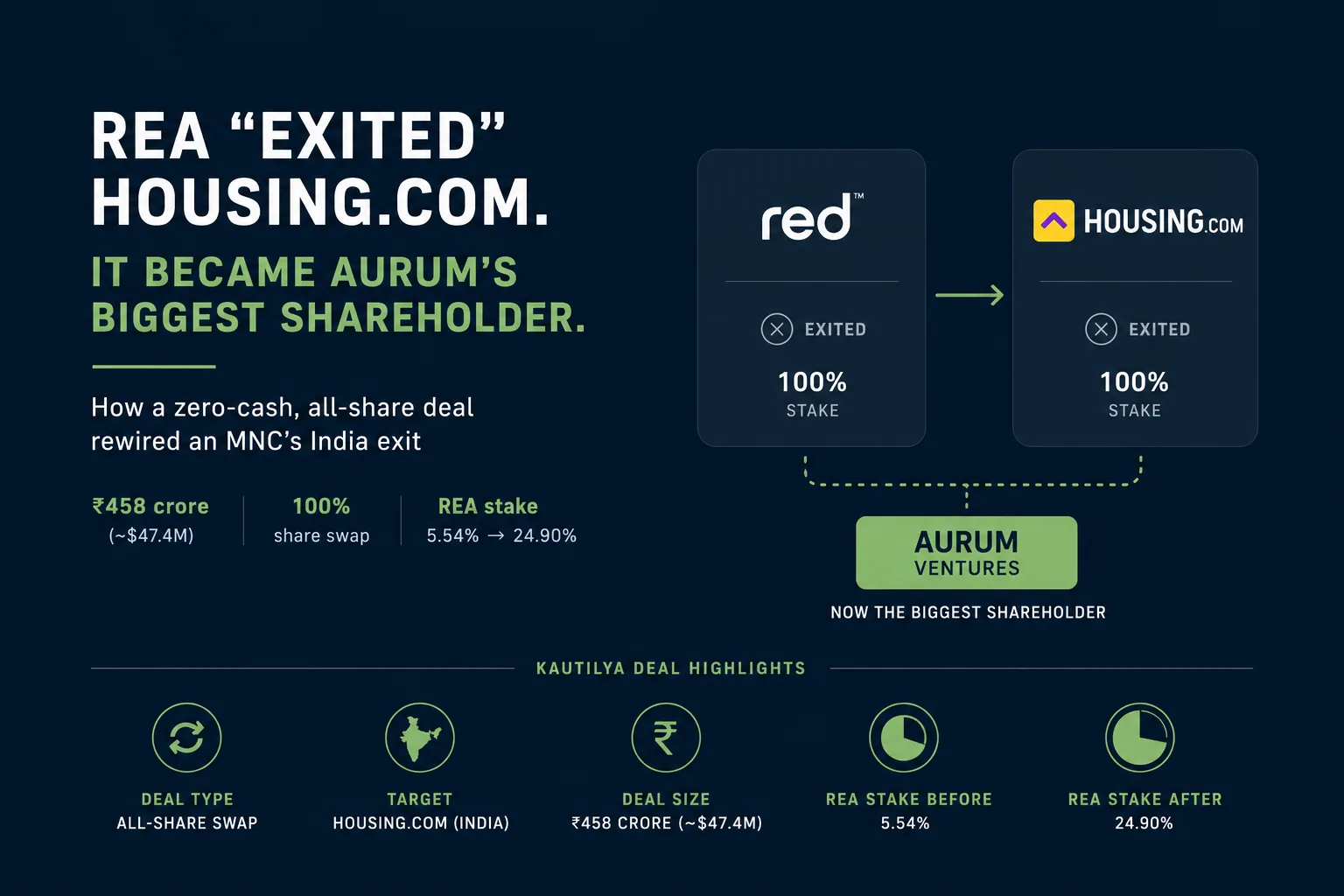
REA Group “exited” Housing.com for ₹458 crore (~$47.4M), and took every rupee of it in stock, not cash. REA's stake in the acquirer, listed proptech Aurum PropTech, jumped from 5.54% to 24.90%, making the seller the single largest non-promoter shareholder of the company that just bought its India business. On the reported numbers, this books REA a AUD 110 million (~$77M / ~₹744 crore) loss. But REA didn't leave India; it rotated. Operating control of one portal traded for a quarter of a listed acquirer. For any advisor sitting across from an MNC parent that's done running its Indian subsidiary, this all-share, all-stock structure is now the template to know.
The Snapshot
| Buyer | Aurum PropTech Ltd (BSE-listed; formerly Majesco) |
| Target | Locon Solutions Pvt Ltd, parent of Housing.com |
| Seller | REA India Pte Ltd (REA Group, Australia) |
| Sector | Proptech / real estate marketplaces |
| Size / price | ₹458.06 crore (~$47.4M), 100% share swap, zero cash |
| Structure | All-share preferential issue: 1,97,93,309 Aurum shares at ₹231.42/share (~$2.40/share) to REA; REA's Aurum stake rises 5.54% → 24.90% |
| Announced | July 16, 2026 (board approval same day; BSE intimation same day) |
| Region | India (target); Australia (seller) |
| Tags |
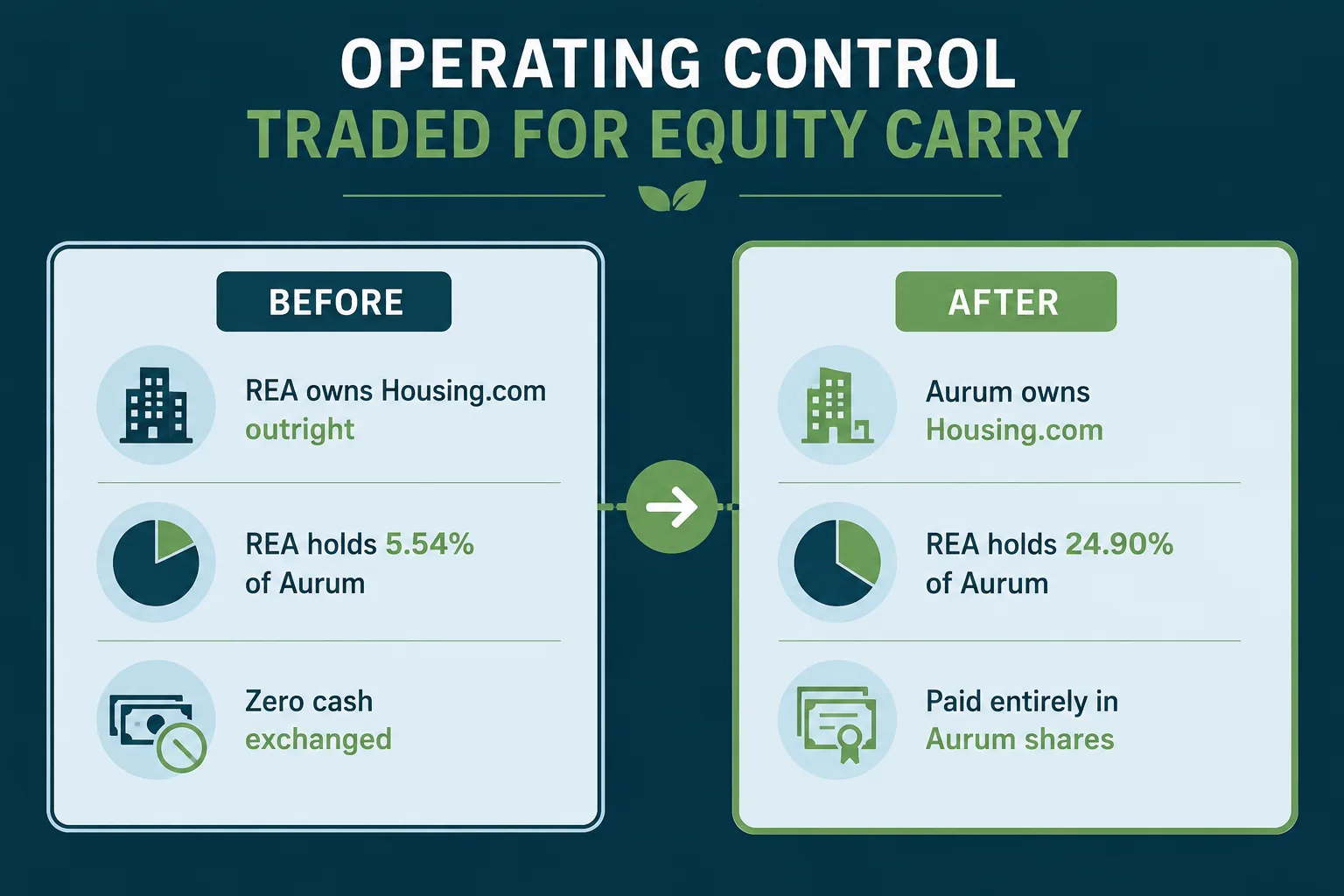
REA didn't sell Housing.com for cash. It swapped operating control for a 24.90% stake in the buyer, converting a portfolio exit that would have crystallized a real loss into a bet on the acquirer's future instead.
What Happened
The announcement
- July 16, 2026: Aurum PropTech's board approves acquiring 100% of Locon Solutions (Housing.com's parent) for ₹458.06 crore (~$47.4M), covering equity shares, compulsorily convertible preference shares, and debentures on a fully diluted basis.
- The entire consideration is paid in Aurum stock: 1,97,93,309 shares issued to REA at ₹231.42/share (~$2.40/share), on a preferential basis. No cash changes hands.
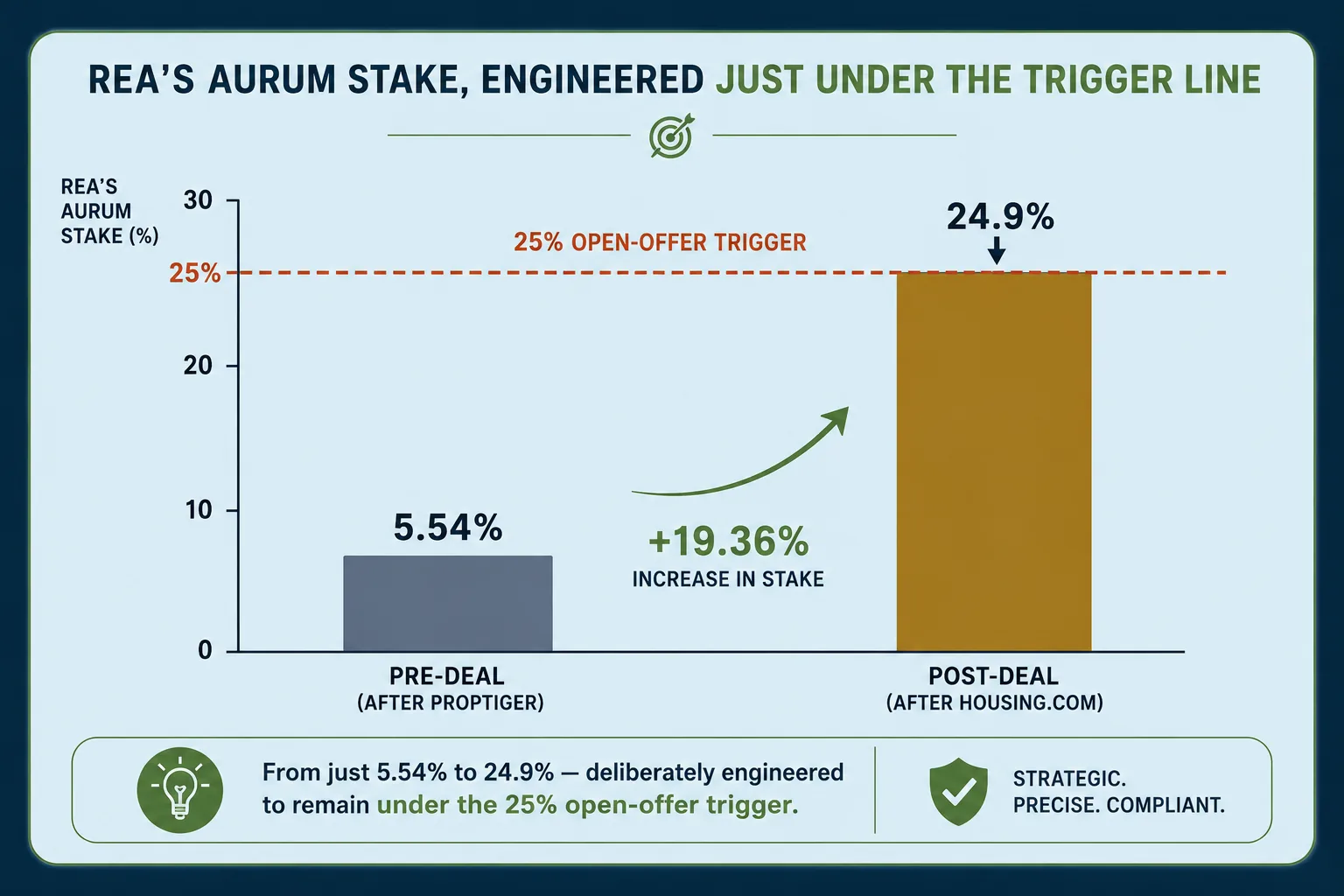
- REA's Aurum stake rises from 5.54% to 24.90%, deliberately just under the 25% threshold that would trigger a mandatory open offer to Aurum's public shareholders.
- Same day, Aurum also issues 51,00,000 warrants to its own promoter at the identical ₹231.42 price (up to ₹118 crore / ~$12.2M), taking promoter holding to 41.17% fully diluted.
The company underneath
- Locon Solutions, founded 2012, owns Housing.com, one of India's largest real estate marketplaces: ~58 million average monthly visits, ~12 million monthly active users, spanning search, developer inventory, brokerage, and rentals.
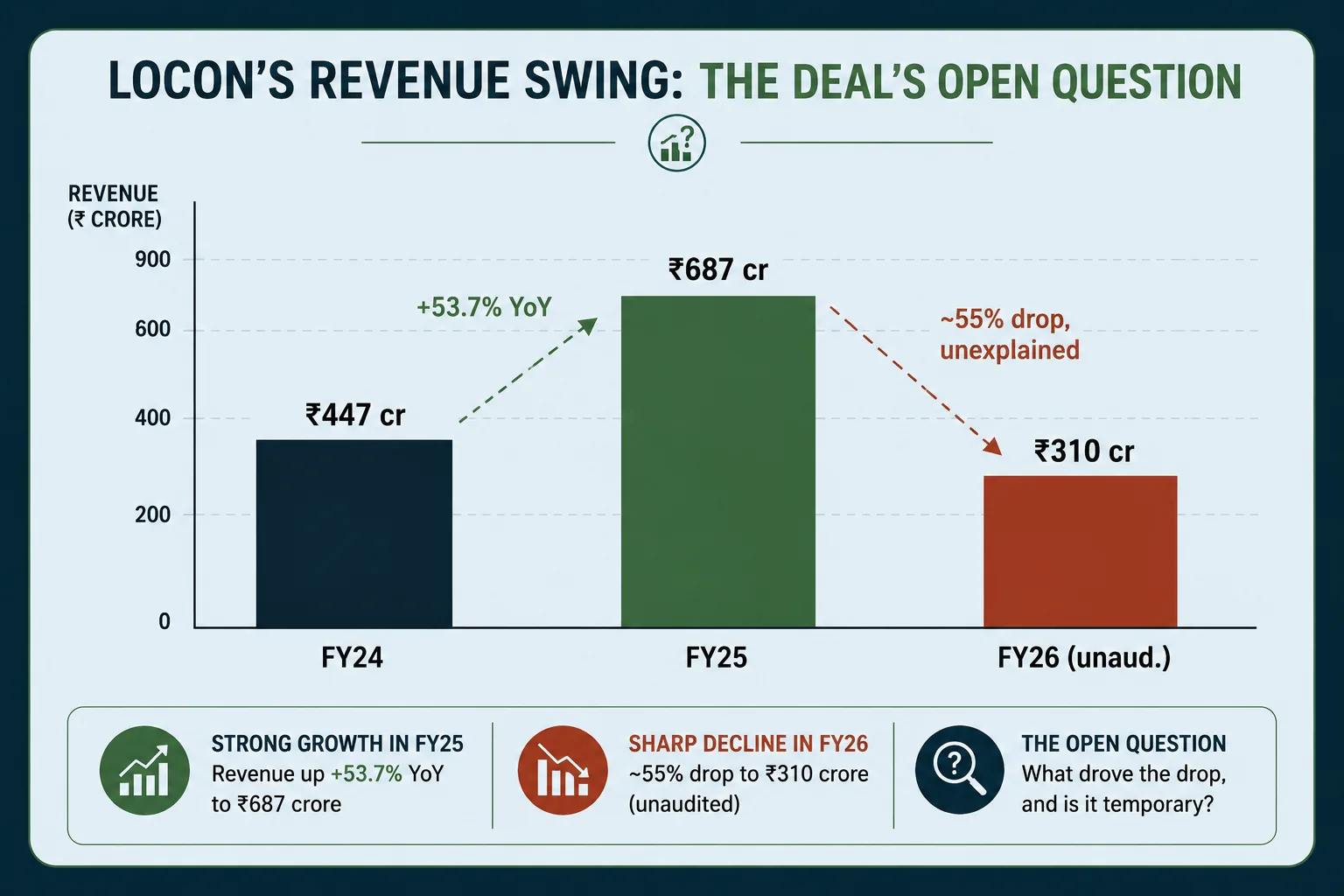
- Locon's revenue: FY24 ₹447.49 crore (~$46.3M), FY25 ₹687.46 crore (~$71.2M, +53.7% YoY), FY26 ₹309.93 crore (~$32.1M, unaudited). That's a ~55% drop from FY25 that is not yet explained in public filings.
- Aurum itself: ₹241.19/share (~$2.50/share) on deal day, ~₹1,738 crore (~$180M) market cap, 52-week range ₹151.90–264.64 (~$1.57–$2.74), trading around a P/E of ~96.
The timing
- This is REA's second asset sold to Aurum. PropTiger went across in September 2025 for ₹86.45 crore (~$9.0M), an all-share deal that first took REA to its 5.54% starting stake.
- REA entered India in January 2017 via Elara Technologies, investing US$50M (~₹483 crore at current rates, for scale reference only, not the 2017 historical rate) to combine PropTiger and Housing.com. Total investment over nine years reached roughly AUD 300 million (~$210M / ~₹2,029 crore).
- Two all-share swaps, eighteen months apart, took REA from an operator with ~$210M invested to a 24.90% shareholder with zero cash recovered: a full rotation, not a single event.
The Numbers
| Metric | Value | Period | Status |
|---|---|---|---|
| Deal value | ₹458.06 crore (~$47.4M) | At announcement | Reported (BSE filing) |
| REA's total India investment | ~AUD 300M (~$210M / ~₹2,029 crore) | 2017–2026 | Reported |
| Implied loss to REA | ~AUD 110M (~$77M / ~₹744 crore) | On reported metrics | Reported |
| Shares issued to REA | 1,97,93,309 at ₹231.42/share (~$2.40/share) | At close | Reported |
| REA's Aurum stake, pre → post | 5.54% → 24.90% | At close | Reported |
| Locon revenue, FY24 | ₹447.49 crore (~$46.3M) | FY24 | Reported |
| Locon revenue, FY25 | ₹687.46 crore (~$71.2M) | FY25 | Reported |
| Locon revenue, FY26 | ₹309.93 crore (~$32.1M) | FY26 | Reported, unaudited |
| Deal multiple | ~0.67x FY25 revenue | N/A | Estimated: Kautilya calc |
| Prior PropTiger deal | ₹86.45 crore (~$9.0M), all-share | Sep 2025 | Reported |
| Aurum market cap, deal day | ~₹1,738 crore (~$180M) | Jul 2026 | Reported |
What we can infer
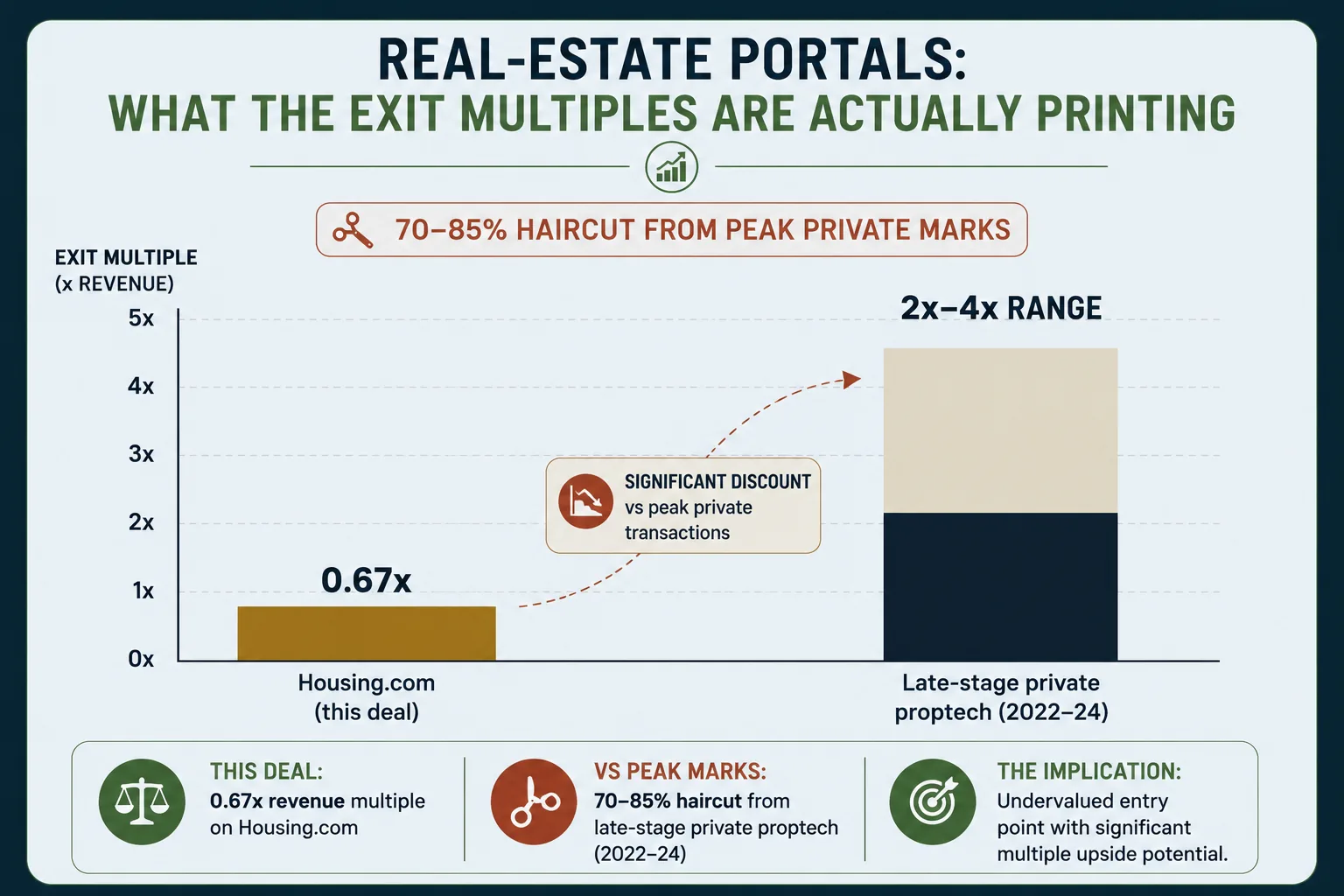
- The ~0.67x FY25-revenue multiple (₹458 crore deal value ÷ ₹687 crore FY25 revenue) is a genuinely low print for Indian consumer-tech: a 70 to 85% haircut against the 2x to 4x revenue multiples late-stage proptech rounds fetched in 2022 to 24.
- That low multiple reflects three things at once, not one: FY26 revenue softness, REA's priority on exiting rather than maximizing price, and consideration paid in equity rather than cash (which itself tends to price cheaper than a cash deal would).
- A pure-cash version of this same deal would likely have printed even lower. The equity structure is doing some of the work of making 0.67x look acceptable to REA at all.
The open question the piece can't resolve
- Locon's disclosed FY26 revenue of ₹309.93 crore (~$32.1M) is down roughly 55% on FY25's ₹687.46 crore (~$71.2M), and it's explicitly marked unaudited. The deal's Regulation 30 annexure sizes the target on the FY25 figure, not FY26.
- Aurum's diligence evidently judged the drop recoverable, or a basis artefact, but that judgment isn't explained in the material available. The EGM notice (August 14, 2026) is where that explanation should surface, and it hasn't yet.
The Structure
This is an all-share preferential issue engineered around a specific regulatory line. The design carries as much of the story as the price.
- Zero cash, entirely in stock. Aurum pays for a ₹458 crore (~$47.4M) acquisition, more than a quarter of its own ~₹1,738 crore (~$180M) market cap, without touching its treasury or raising new public capital.
- Priced at the regulatory floor. ₹231.42/share (~$2.40/share) is the SEBI ICDR floor (the higher of the 90-day or 10-day VWAP), sitting about 4% below Aurum's deal-day close of ₹241.19 (~$2.50).
- 24.90% is an engineered ceiling, not a coincidence. Crossing 25% would trigger a mandatory open offer to Aurum's public shareholders under India's Takeover Regulations. Landing at 24.90% is the deliberate stop just short of that line.
- A three-year lock-in. SEBI's rules on preferential allotments to non-promoters lock REA out of selling its new shares until roughly Q3 FY29.
Which risk did each side actually manage, and which did they leave open?
- Aurum's managed risk. It bought scale (58 million monthly visits, a major consolidation move) without straining its balance sheet, and it avoided both a cash outlay and a public dilution event. The preferential-to-one-named-allottee route sidesteps both.
- REA's accepted risk. It converted a certain, crystallized loss into an uncertain, three-year-locked bet on Aurum's share price. Whether that trade pays off depends entirely on Aurum successfully integrating Housing.com and re-rating, a risk REA now carries for three years with no ability to exit early.
Why It Matters
Aurum's framing, “we're consolidating the sector,” is true but incomplete. Three sharper reads:
REA rotated its exposure; it didn't reduce it. Taking ₹458 crore (~$47.4M) in cash would have crystallized the AUD 110M (~$77M) loss and ended REA's India story cleanly. Instead, REA holds 24.90% of the combined platform. Any post-integration re-rating of Aurum flows back to REA, for better or worse. This is a portfolio rotation wearing the language of a divestment, not an actual exit.
Every listed mid-market acquirer with a credible share price now has this playbook. Aurum moved ₹458 crore (~$47.4M) of value without a rupee of cash or a public capital raise. The preferential-issue-to-one-named-allottee route is available to any listed company with stock investors will accept as payment. Expect more stock-for-asset offers from listed Indian acquirers chasing consolidation, not just this one.
India's independent proptech portal count just dropped to three. Housing.com and PropTiger now both sit under Aurum. Magicbricks belongs to Times Group; 99acres to Info Edge; NoBroker and a handful of smaller players are what's left independent. A founder-owned proptech business shopping for a strategic buyer just lost a seat at the table.
The Buyer's Takeaway
Written for the advisor/operator lens, what this teaches someone structuring an exit for a foreign parent, or a consolidation for a listed acquirer:
- 1. An all-share preferential issue is a real alternative to a cash sale, not a consolation prize. If your client is an MNC parent done running its Indian subsidiary, this structure preserves India upside instead of forcing a clean, lower-value cash exit. Model the three-year lock-in and the seller's ongoing exposure to the buyer's share price before calling it worse than cash.
- 2. Watch for the number just under a regulatory trigger. 24.90% next to a 25% open-offer threshold is not a coincidence; it's an engineered ceiling. Any large preferential allotment landing suspiciously close to a regulatory line deserves a second look at what threshold it's avoiding.
- 3. An unexplained revenue swing doesn't have to kill a deal, but it should change your price. Locon's FY26 revenue nearly halved from FY25, unaudited, unexplained in public filings, and the deal still priced off the higher FY25 figure. If you're advising the buyer side, that's exactly the kind of gap that should show up as a lower multiple or a holdback, not get absorbed silently.
The limit: this structure depends on the buyer being listed with a share price sellers are willing to accept as payment, and on the seller genuinely preferring optioned upside over a clean cash exit. A seller who needs cash now, or a buyer whose stock isn't credible currency, can't run this playbook.
The Kautilya Deal Score
| Price Discipline | ★★★★⯨4.5 |
| Structure & Risk Absorption | ★★★★⯨4.5 |
| Cash-Flow Quality | ★★☆☆☆2 |
| Strategic Fit / Value Path | ★★★★☆4 |
| Replicability | ★★★★☆4 |
| Overall | ★★★⯨☆3.8 |
Verdict: Solid. An exceptionally well-engineered structure, cheap for the buyer, cash-preserving, regulatorily precise, built on top of a target whose most recent year of revenue is a genuine, unresolved red flag. The structure is the transferable lesson; the FY26 numbers are the reason this isn't scored higher.
“I'd study this structure harder than I'd study this specific deal. Getting a cash-strapped listed acquirer to pay for a real asset with paper, at a price barely inside the regulatory floor, while locking the seller in for three years, that's genuinely elegant dealmaking, and it's replicable well below this deal's size. What I wouldn't do is treat the 0.67x multiple as evidence Aurum won on price alone; nobody has explained why Housing.com's revenue nearly halved in FY26, and until that's on the record, I'd want that gap priced into the deal, not waved through on FY25's numbers.”
Sources, by confidence
- High: Deal terms, structure, share issuance, and stake mechanics — Aurum PropTech's BSE intimation (July 16, 2026).
- High: Deal narrative, prior PropTiger deal, revenue figures — Business Standard, Entrackr, Business Upturn.
- Medium-high: Aurum market cap, share price history, promoter holding — Screener.
- Medium-high: REA's nine-year India investment history — RP Realty Plus, Elite Agent, Entrackr.
- Medium: Comparable proptech valuation multiples (2022 to 24 private rounds) — Kautilya sector analysis, not independently re-verified per source in this pass.
Kautilya's own calculations (not disclosed figures)
The ~0.67x FY25-revenue multiple, and every USD conversion of a disclosed ₹ or AUD figure in this piece (converted at approximate July 2026 spot rates: ~₹96.6/$1, ~$0.70/AUD1, sourced via live web search, not a fixed internal rate; treat every converted figure as directional, not exact).
Open items we could not verify
- Why Locon's FY26 revenue fell ~55% from FY25. No public explanation exists yet; the EGM notice (August 14, 2026) may address it.
- Whether the ~0.67x multiple would look materially different computed against FY26's (lower, unaudited) revenue instead of FY25's.
- The precise terms of REA's three-year lock-in beyond the standard SEBI non-promoter preferential-allotment rule.
Every Kautilya Teardown tags buyer, target, structure, and score the same way, so you can compare them later. Get the next one the day it publishes.
Read More TeardownsSubscribe on Beehiiv