
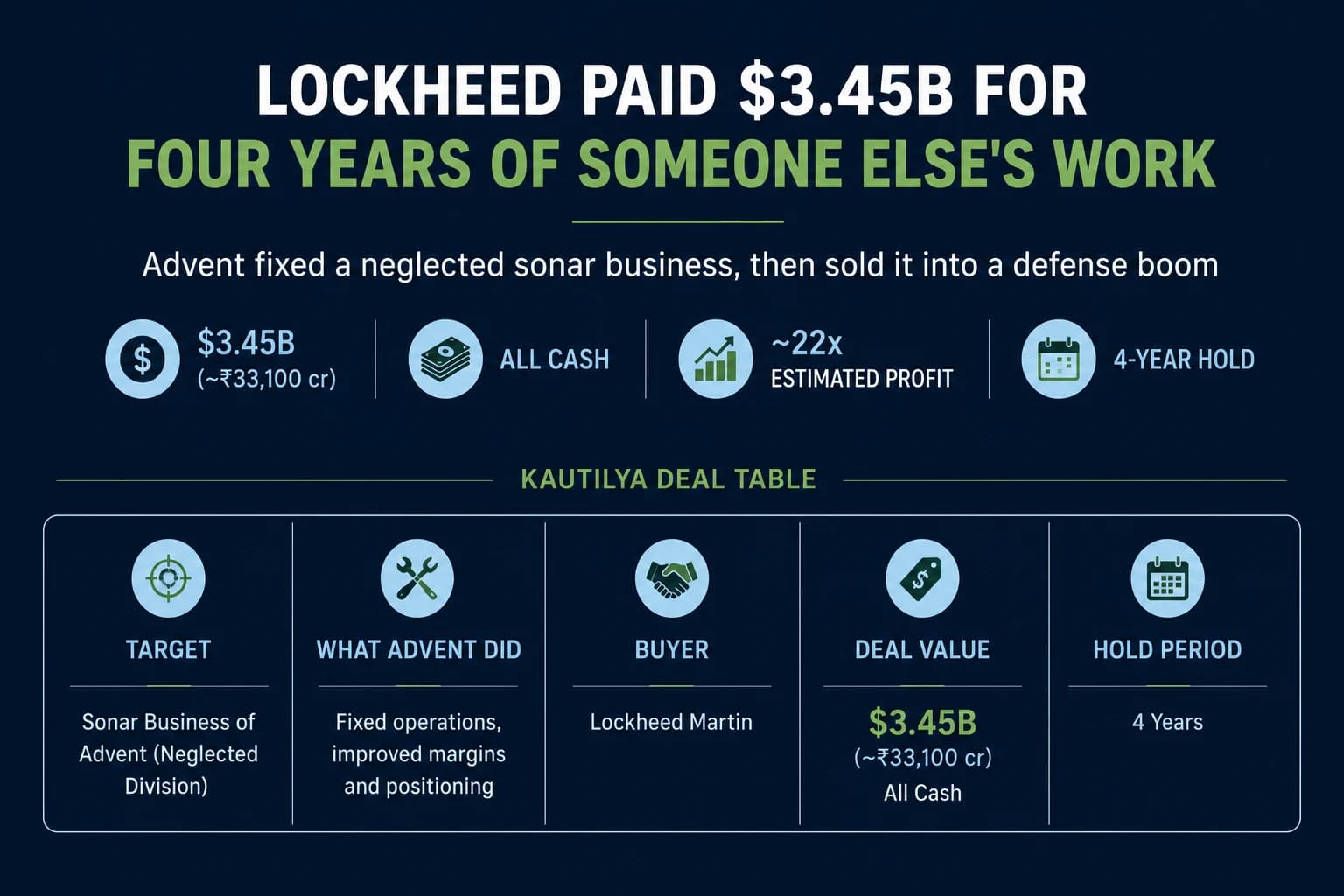
Lockheed Martin acquired Ultra Maritime from private equity firm Advent International for $3.45 billion (~₹33,100 crore) in an all-cash transaction announced July 6, 2026. The company specializes in undersea warfare systems, including sonobuoys, sonar systems, torpedo-defence countermeasures, radar, and autonomous maritime sensing platforms.
It is a clean, fast-moving deal on paper. What makes it worth a teardown is everything sitting underneath the headline number: a textbook private-equity value-creation cycle, a multiple well above the sector norm, and a critical data gap that makes the return on that value creation impossible to verify.
Advent's Value Creation, Run in Full
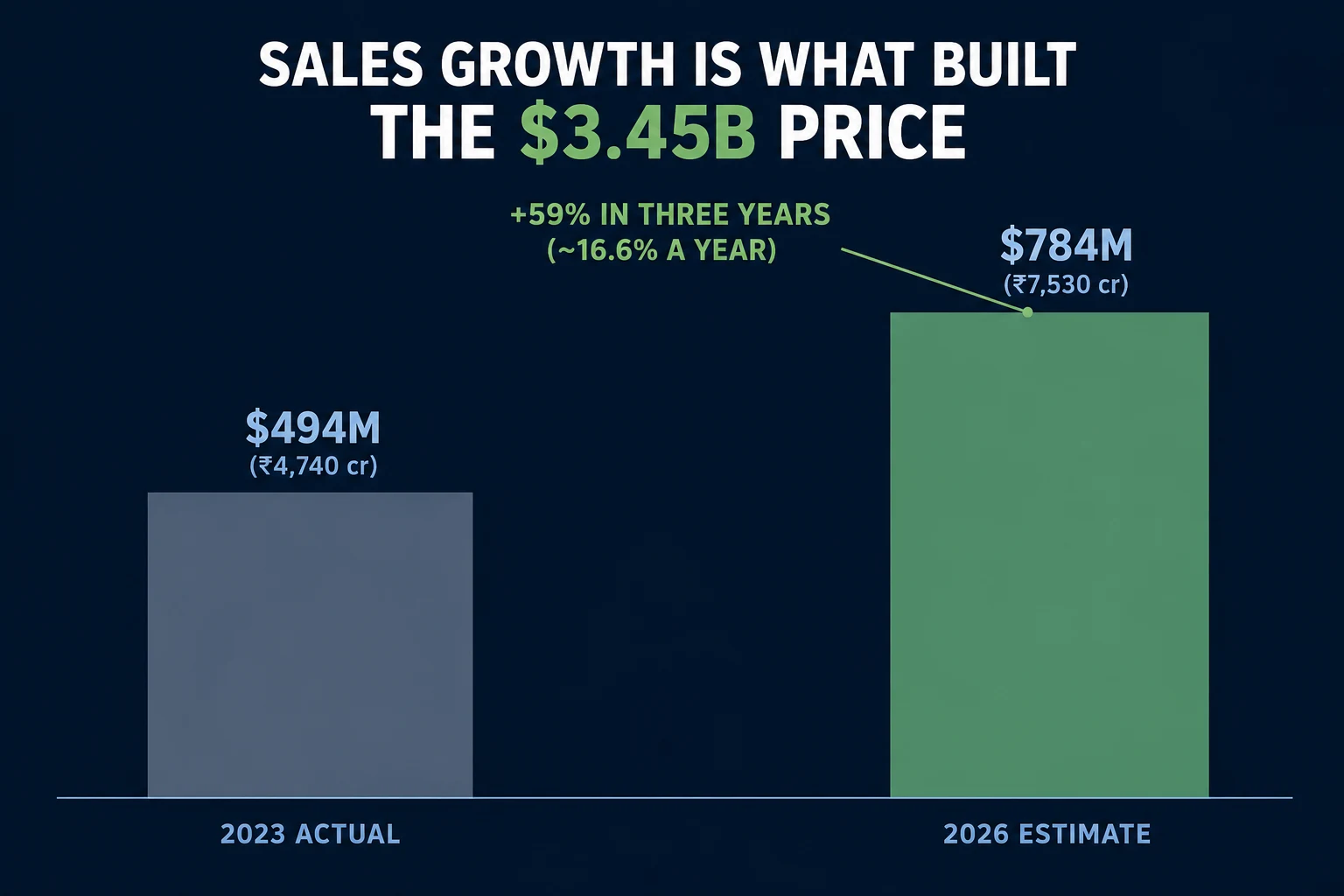
Advent purchased Ultra Maritime in 2022 as part of a larger UK take-private. Over four years, the firm invested approximately $170 million (~₹1,630 crore), growing annual revenues from $494 million (~₹4,740 crore) in 2023 to an estimated $784 million (~₹7,530 crore) in 2026 — roughly 59% growth across three years, or about 16.6% a year.
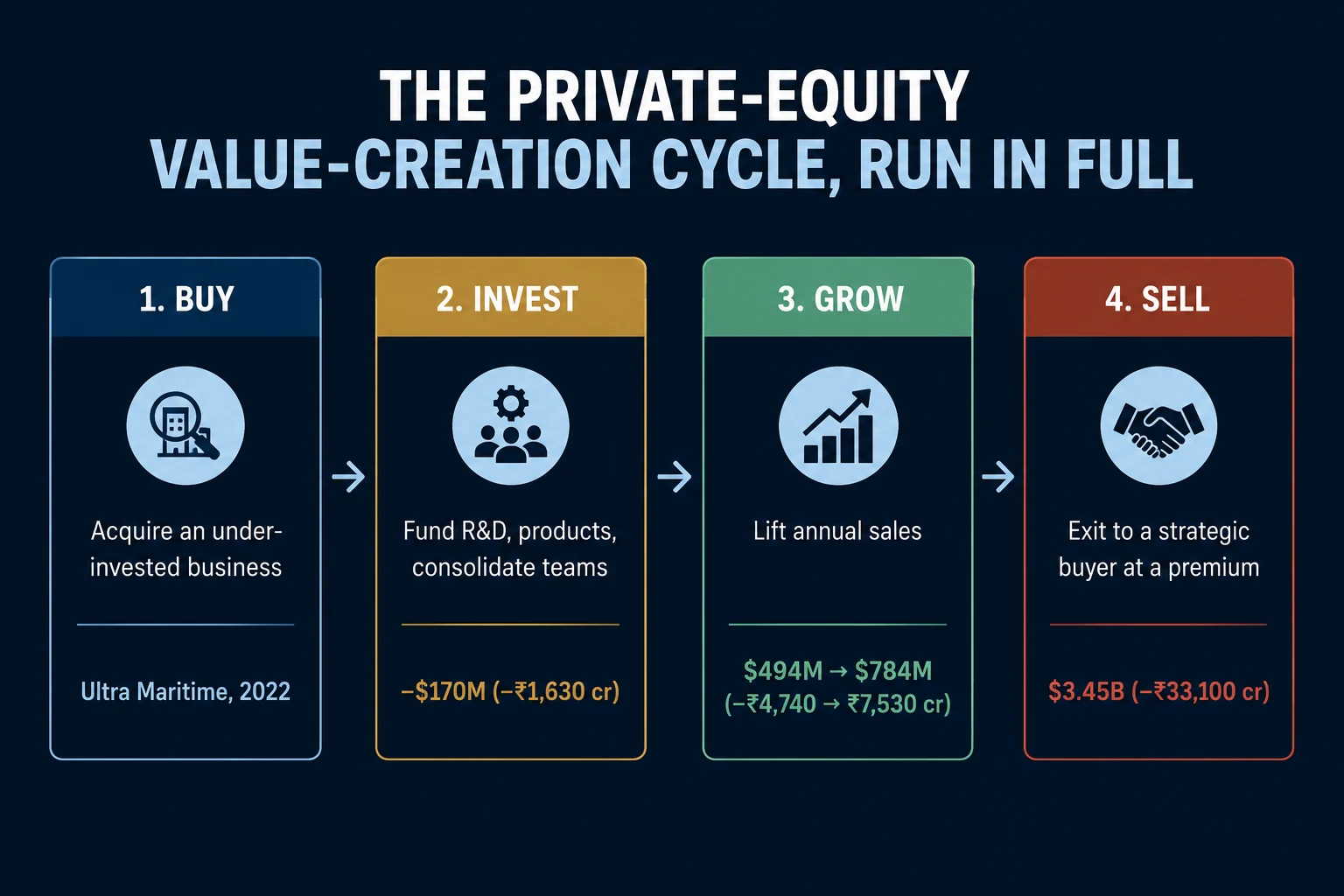
This is the four-stage playbook in its most textbook form: buy an under-invested asset, fund the fixes it was starved of, grow the top line, and exit to a strategic buyer willing to pay for what the fixing produced.
Why the Price Matters
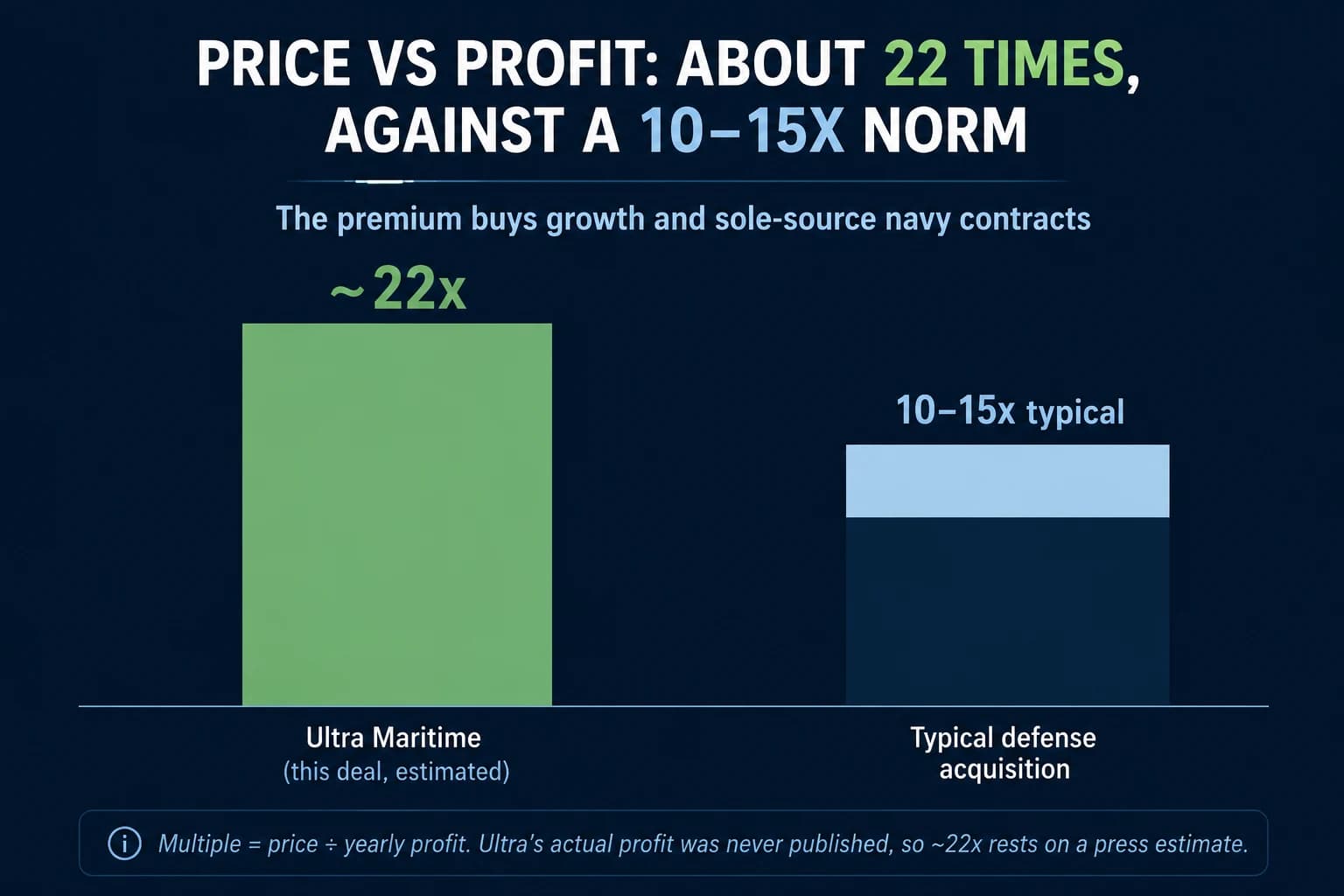
The acquisition carries an estimated 22x EBITDA multiple, significantly above the typical 10–15x range for defense deals.
The article framing this deal calls it “a strategically excellent purchase at an uncomfortable price” — Lockheed pays entirely in cash with no earnout protections, a structure that puts the full valuation risk on the buyer at closing rather than tying any of it to Ultra Maritime's future performance. The deal also addresses a real weak spot: operating profit in Lockheed's Rotary and Mission Systems division fell 19% to $423M in Q1 2026.
Zoomed out, the check size is large in absolute terms but modest against the size of the buyer writing it.
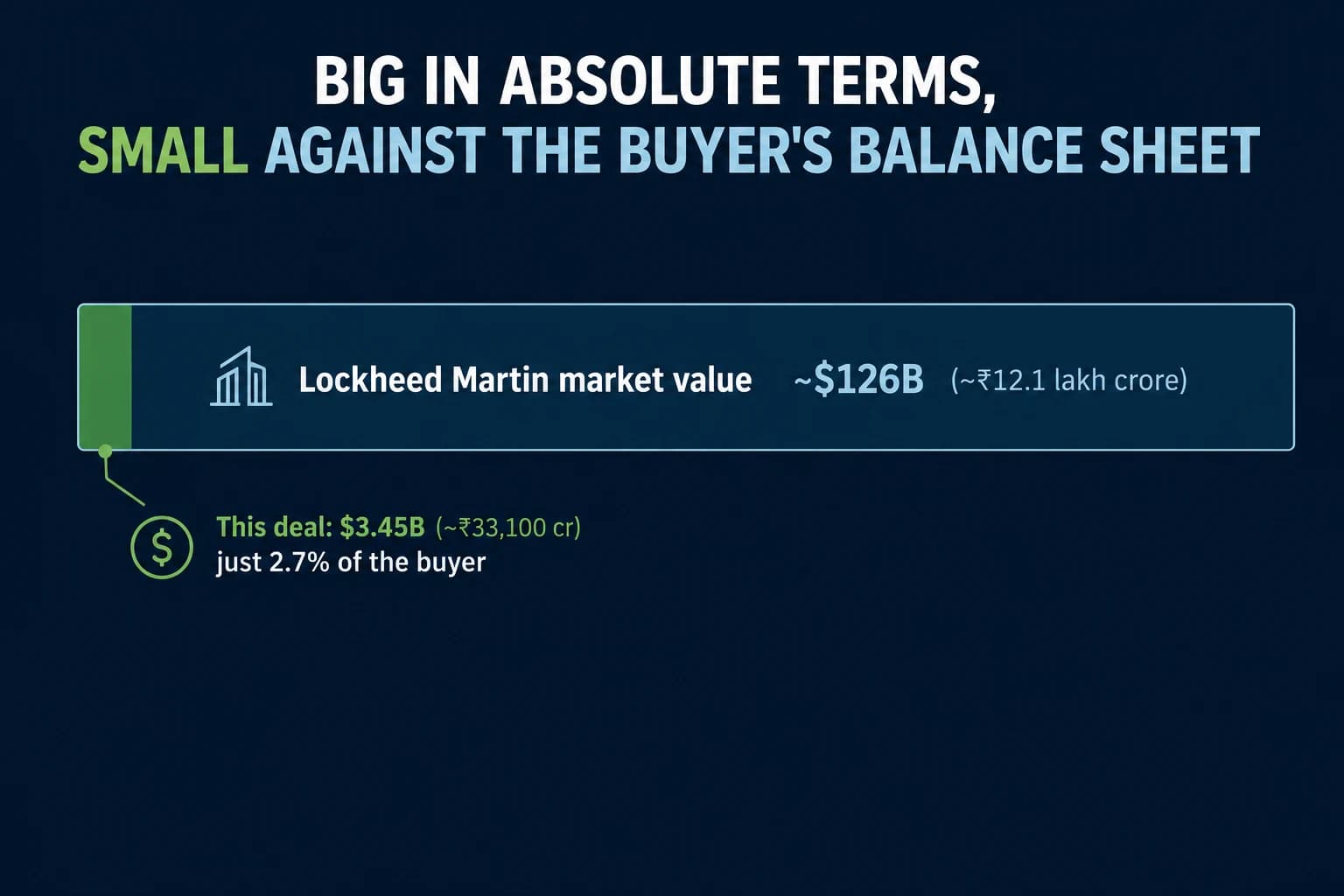
At $3.45 billion, the deal is just 2.7% of Lockheed Martin's roughly $126 billion market value — a premium multiple, but one the buyer can absorb comfortably.
The Critical Knowledge Gap
Advent's original 2022 purchase price for Ultra Maritime was never disclosed, making it impossible to calculate the firm's actual return on investment. The value-creation story above — the $170 million invested, the revenue growth, the exit at 22x — is real and well documented on the exit side. What is missing is the entry price, and without it, this deal is a strong illustration of the private-equity playbook, not a verifiable case study of the returns it produced.
| Metric | Figure |
|---|---|
| Deal value | $3.45B (~₹33,100 cr), all cash |
| Estimated EBITDA multiple | ~22x, vs. 10–15x typical for defense deals |
| Advent's investment | ~$170M (~₹1,630 cr) over four years |
| Revenue growth | $494M (2023) to ~$784M (2026 est.), +59% in three years |
| Hold period | 4 years (2022–2026) |
| Deal size vs. buyer market cap | 2.7% of Lockheed Martin's ~$126B market value |
| Advent's original entry price | Undisclosed — ROI cannot be calculated |
Lockheed Martin acquired Ultra Maritime from Advent International for $3.45 billion in an all-cash transaction, announced July 6, 2026.
Ultra Maritime specializes in undersea warfare systems, including sonobuoys, sonar systems, torpedo-defence countermeasures, radar, and autonomous maritime sensing platforms.
Advent's original 2022 purchase price for Ultra Maritime was never disclosed, so the actual return on investment cannot be calculated. What is known: Advent invested roughly $170 million over four years and grew revenue from $494 million (2023) to an estimated $784 million (2026), about 59% growth in three years.
The deal carries an estimated 22x EBITDA multiple, well above the typical 10-15x range for defense transactions. The premium reflects Ultra Maritime's growth trajectory and sole-source navy contracts, and addresses a 19% profit decline in Lockheed's Rotary and Mission Systems division in Q1 2026.
Lockheed paid entirely in cash with no earnout protections, meaning the full purchase price was committed upfront with no structure tying payment to Ultra Maritime's future performance.
Deal facts
- Public reporting on the Lockheed Martin–Advent International transaction, announced July 6, 2026: deal value, cash structure, Ultra Maritime's product lines, Advent's 2022 entry via a UK take-private, and Lockheed's Rotary and Mission Systems Q1 2026 results.
Kautilya's own calculations, not disclosed figures
Every rupee conversion on this page, at ~₹96.6/$1 (July 2026). The 22x EBITDA multiple and the 2.7%-of-market-cap figure are estimates derived from reported deal value against press-estimated profit and Lockheed Martin's public market capitalization, not disclosed by either party.
Open items
- Advent's original 2022 acquisition price for Ultra Maritime was not disclosed and is not available from any source reviewed. Return on investment for Advent cannot be calculated without it.
- Ultra Maritime's actual EBITDA has not been published; the ~22x multiple rests on a press estimate, not a reported financial statement.
Not investment advice. This is a deal teardown for readers evaluating acquisition structures and buy-side value creation, not a recommendation regarding any security.
Every Kautilya Teardown tags buyer, target, structure, and score the same way, so you can compare them later. Get the next one the day it publishes.
Read More TeardownsSubscribe on Beehiiv